

Springs play an essential role throughout the medical sector, supporting everything from handheld drug delivery devices to large diagnostic systems and adjustable hospital equipment. Although many of these components are hidden inside finished products, they are responsible for delivering precise movement, controlled force and dependable performance where reliability matters most.
Choosing the right spring for a medical application depends on much more than its dimensions. Engineers must consider factors such as load requirements, available space, material selection, durability and the demands of repeated sterilisation. Selecting the correct spring early in the design process helps improve long-term performance while reducing unnecessary redesigns later.
In this guide, we explore the main types of springs used in medical devices, where they are commonly found, and why selecting an experienced manufacturing partner is an important part of developing reliable healthcare equipment.
Choosing the Right Spring for Medical Applications
Every medical device performs a different function, which means there is no single spring suitable for every application. A spring used inside an inhaler has very different requirements from one supporting a hospital bed or diagnostic imaging system.
When specifying a medical spring, engineers should consider:
- The amount of force required
- The available installation space
- Expected operating cycles
- Exposure to cleaning chemicals or sterilisation
- Corrosion resistance
- Material compatibility
- Manufacturing tolerances
Working with an experienced spring manufacturer during the design stage helps ensure the correct spring type is selected before production begins, improving efficiency and reducing costly modifications later in the project.
Compression Springs for Drug Delivery and Medical Devices
Compression springs are among the most commonly used springs in the medical sector, thanks to their versatility and reliability. These springs feature a helical design, enabling them to store and release mechanical energy through compression and decompression. Their simple yet effective function makes them indispensable in various healthcare applications.
One everyday example of compression springs in medicine is their use in inhalers. Here, the spring applies force to move medication from the canister into the mouthpiece, where it can be inhaled by the patient.
In surgical instruments like clamps and scissors, compression springs help maintain consistent pressure, ensuring secure tissue handling during procedures. The use of high-quality, durable springs is crucial in these tools, as precision is essential for successful surgical outcomes.
Compression springs are also integral to ventilators, where they help regulate airflow by controlling the pressure of delivered air, a critical function that supports patient breathing.
Compression springs are equally important in auto-injectors, insulin pens, and other drug delivery devices. These products rely on carefully controlled spring force to deliver accurate medication doses consistently throughout the product’s service life. Even small variations in spring performance can affect device reliability, making precision manufacturing and repeatable quality essential.
From life-saving devices to everyday medical tools, compression springs serve as a reliable and versatile component, contributing significantly to the efficiency and safety of healthcare equipment.

Gas Springs for Adjustable Medical Equipment
Gas springs, otherwise known as gas struts, are springs that incorporate compressed gas into their functionality. They have a variety of applications, from vehicles to adjustable furniture, and are designed to lift, lower, and control the movement of heavy loads.
Within the healthcare industry, gas springs are used in hospital and physiotherapy beds, enabling height adjustment and back or leg elevation, helping to comfort the patient and make treatment easier for medical workers. The same functionality applies to things like drug cabinets and mobile workstations, assisting with height adjustment, angle readjustment and the control of lid opening and closing.
Gas springs are commonly found in operating theatre lighting arms, X-ray equipment and medical display screens. Similar systems are also used in dental and optical practices where precise positioning improves both patient care and practitioner comfort.
Because these products are adjusted repeatedly throughout the day, reliability and smooth movement are essential. Gas springs help reduce manual effort while allowing equipment to remain securely positioned during use.

Torsion Springs in Diagnostic Equipment and Prosthetics
Torsion springs work by applying a twisting force rather than a compressive force. When the spring is twisted, it stores energy that is released when the spring reverts to its original position.
Medical mobilisation devices and hospital beds utilise torsion springs. They assist in smoothly raising or lowering sections of a hospital bed with minimal effort, as well as allowing the beds to lock into place once the desired position is achieved.
Torsion springs can also be found in diagnostic equipment, such as blood analysers, where they help to achieve the precise movement and handling of blood samples.
They also play a vital role in surgical robotics and prosthetics, helping to create controlled movement that closely replicates natural joint motion.
Depending on the application, engineers may also consider extension springs, constant force springs or wave springs where different movement characteristics or compact installation space are required. Selecting the appropriate spring depends on the intended function, available space and expected operating life.

Medical Pressings and Metal Stampings
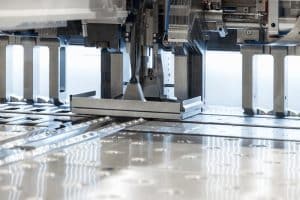
In addition to springs, pressings and stampings have an abundance of uses in the medical sector. Metal stampings are created using a process of cutting or shaping metal sheets and can create a variety of components.
When manufacturing components for healthcare applications, material quality is essential. Stainless steel remains one of the most widely used materials because of its excellent corrosion resistance, durability and suitability for demanding medical environments.
Many medical products incorporate precision pressings, including:
- Surgical instruments
- Medical device enclosures
- Imaging systems
- Medical device housings
- Laboratory equipment
- Temperature probes
When it comes to pressings and stampings, we are equipped to manufacture bespoke components in material thicknesses between 0.05mm and 4mm.
Many applications also require tight manufacturing tolerances and complete material traceability to ensure consistent performance across every production batch.
Materials Used for Medical Springs
Material selection has a direct impact on the performance and lifespan of a medical spring. Different applications require different material characteristics depending on their operating environment and intended function.
Stainless steel remains one of the most common choices because it combines excellent corrosion resistance with long-term durability. Other specialist alloys may be selected where higher strength, improved fatigue performance or enhanced resistance to challenging environments is required.
When selecting materials, engineers typically consider:
- Corrosion resistance
- Fatigue life
- Repeated sterilisation
- Mechanical performance
- Long-term reliability
Selecting the right material during the design stage helps ensure the finished component performs consistently throughout its service life.
Working with an Experienced Medical Spring Manufacturer
Medical devices depend on components that perform reliably every time they are used. Whether you require compression springs, torsion springs, gas springs or precision pressings, choosing an experienced manufacturing partner helps ensure every component is produced to the required specification.
At European Springs & Pressings Ireland, we manufacture bespoke springs and pressings for demanding medical applications using advanced manufacturing capabilities and rigorous quality processes. If you are developing a new medical device or refining an existing design, our engineering team can help identify the most suitable solution for your application. Request a quote today to discuss your requirements.